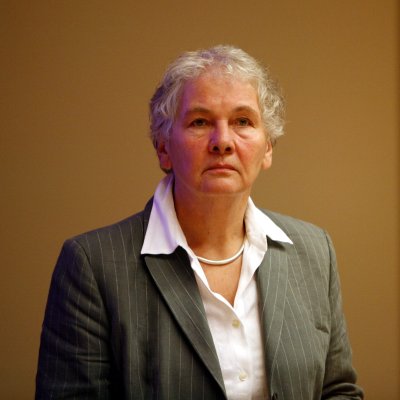
Which teacher, parent, coach or friend most made you who you are, and what did you learn from them?
Recorded Christiane Nüsslein-Volhard said elsewhere, not written here
we had a wonderful education because my parents were so practical … Christiane Nüsslein-Volhard: Yes I mean, I have a strong likeness of culture and also I mean my grandmother was a painter and we do music in the family quite a lot and I think that’s very important. What was also important, I thought about that recently, also maybe as a follow-up of an interview but I was asked what my parents did and so on and looking at my brothers and sisters, we had a wonderful education because my parents were so practical, they did books themselves and we did a lot of handicrafts and I knew how to knit and sew and cook and we learnt a lot to do things ourselves, to make things ourselves so we all have some dexterity in doing things ourselves and this is also very important for Science

Marika Griehsel, Interview at the 53rd Lindau Nobel Laureate Meeting, 30 June–4 July 2003, Nobel Prize Outreach, 1 July 2003 source ↗

Others on this question

View all 57 →
Bill Clinton 42nd President of the United States, 1993–2001
So Quigley taught a course called “The History of Civilizations,” and at the end, he said that the great gift of Western civilization to the human race was the idea of progress in a very specific way. He said it was the idea that the future can be better than the present and that every single person, not just the rulers, not just the elected leaders, not just the billionaires, every person has a personal moral obligation to make it so, to keep it going, to make the future better. And it resonated with me. I thought, “That’s the purpose of politics.” It made me really think even more than I had before that I might like a career in public service. It also made me aware of why in the aftermath of something like the 2008 crash you are going to have so much disorientation and anger and frustration because too many people have gotten up every day, and some still do, and looked in the mirror and thought all their tomorrows were going to be like yesterday. It’s the ultimate disempowerment. There’s nothing you can do for yourself, and even worse, for your family. It’s going to be all the same, and Quigley made us understand that our whole culture in Western civilization was designed to counter that, to believe that you personally could make a difference, and I never got over it.
Recorded Academy of Achievement interview source ↗
Frederick W. Smith Founder and long-serving chairman of FedEx Corporation
He was a little guy who was a great football player at Georgia Tech, and he just was indefatigable. He just would never, ever say die. He absolutely proved to me that persistence was a very big part of making it in life. I never forgot that lesson.
Recorded Academy of Achievement interview source ↗
Ralph Nader Lawyer and consumer advocate; author of Unsafe at Any Speed
We used to converse at dinner time around the table. Parents and children. We talked about all kinds of issues. From local, neighborhood issues to world issues. It was back and forth, very lively, and very critical. During our early years my mother would relate historical sagas to us for five or ten minutes every lunch hour, when we would come home from school, and it would be continued the next day. I think that built into us a sense that freedom involves responsibility. It isn’t just waving flags and saying, “Look how free we are,” while people’s rights are being trampled sometimes overtly, sometimes beyond their control.
Recorded Academy of Achievement interview source ↗
Henry R. Kravis Financier; co-founder of Kohlberg Kravis Roberts & Co.
I had a teacher who was a great influence on me, when I was in boarding school at Loomis, Jim Wilson. He was my economics teacher and he was also my dorm head. I didn’t know what economics was before I took this course. I was really moved by the course. I was moved by him. That’s probably one of the reasons I chose the field of business.
Recorded Academy of Achievement interview source ↗

More from Christiane Nüsslein-Volhard

View profile →
Question What is something everyone in your world agrees about that you think is wrong? Values & belief
I continued the work on dorsal, discovered the recessive phenotype and interpreted the phenotype postulating a gradient determining the dorsoventral axis. At that time, gradients were not widely accepted as mechanisms, in particular biochemists were highly sceptical, however the Tübingen influence made such models attractive to me.
Recorded Laureate-written autobiography for Les Prix Nobel, Nobel Prize Outreach, 1 December 1995 source ↗
Question What is your greatest fear? Identity & self
I don’t think it’s misused yet, people are afraid of it might be misused but on the other hand, there is also value in finding out about the relation between several particular predispositions. You might be more careful if you are told that your genetic background is such that you shouldn’t eat fat in large amounts or so, it does help you change your life a little bit and so it’s not so bad, but it’s hard to find out which genetic background is causing these things.
Recorded Marika Griehsel, Interview at the 53rd Lindau Nobel Laureate Meeting, 30 June–4 July 2003, Nobel Prize Outreach, 1 July 2003 source ↗
Question What is the most important lesson life has taught you? Time & hindsight
Not really. I thought that getting the Nobel Prize was a big interruption in my career, I thought and it was very distracting. It takes a lot of time you know, it just takes time to be honoured, you have to travel and you have to give speeches of things you have, oh it’s so often that you get bored to tears when you hear your own voice. And it’s really taking a lot of your time and there’s no way that during this time you can start something new, I mean you just profit from what you’ve done and there is no time to develop new ideas.
Recorded Marika Griehsel, Interview at the 53rd Lindau Nobel Laureate Meeting, 30 June–4 July 2003, Nobel Prize Outreach, 1 July 2003 source ↗
Question What inspires you to learn? Attention & the world
I think a very big curiosity. I’m very curious and I like to understand things and not only science but also other things where I just try to find out why things work or how things work. Science and nature caught my attention as a small child already. I was growing up in a city but we had a garden and I loved the garden and then often on vacation I was at a farm and I loved these animals and plants and so on, so I was attracted very early on and then we had a very good teaching actually at my … I don’t know whether my teachers really had much of a role because I was determined very early, but then I also did music and I did languages and Literature and so on. I have broad interests actually other than science, but this is really true, this curiosity.
Recorded Marika Griehsel, Interview at the 53rd Lindau Nobel Laureate Meeting, 30 June–4 July 2003, Nobel Prize Outreach, 1 July 2003 source ↗

More on relationships

Also answered this

Richard Feynman, Paul Farmer, Robert J. Lefkowitz, Edward Teller, Michael DeBakey, Robert S. Langer

Search the directory for somebody in particular.

Explore further

Report this answer